Post
The pursuit of excellence does not need justification
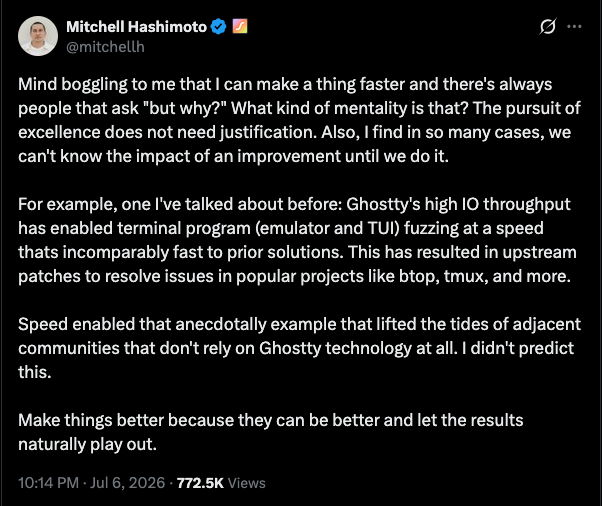
Mitchell Hashimoto put words to something I have believed for years. Make things better because they can be better, and let the results play out.
Mitchell Hashimoto put words to something I have believed for years. In July 2026 he wrote this post on X.
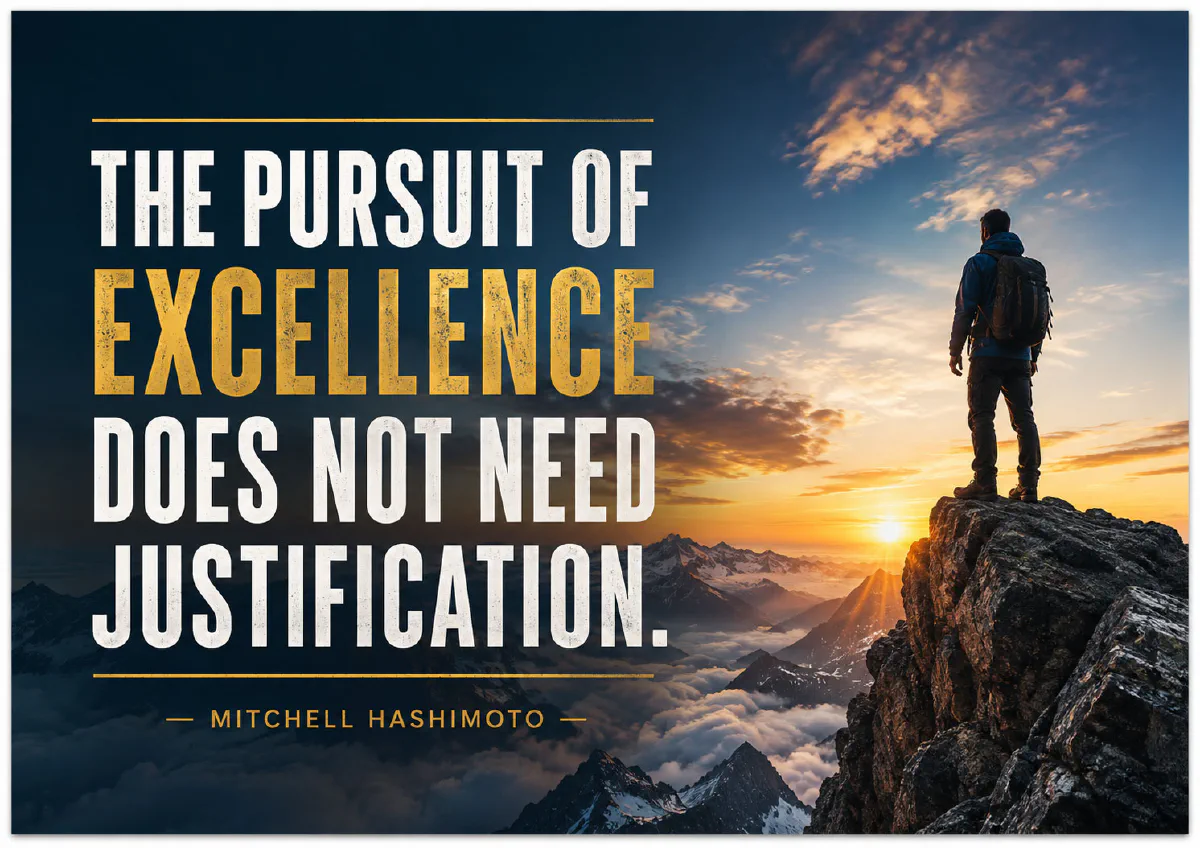
I liked one sentence so much that I turned it into the cheesy cover.
You cannot know until you build it
Ghostty is Mitchell’s terminal emulator, and he has made its IO throughput faster than any human needs for reading text on a screen. That sounds like speed for its own sake.
Then the speed paid off in a way nobody had planned. Faster IO made it practical to test other terminal programs at a speed that was not practical before, and the fixes went to projects that do not use Ghostty at all. People who have never installed Ghostty now run better software because one person made a terminal faster than anyone asked for. He did not predict this. He could not have. The improvement had to exist before its impact could be discovered.
Excellence compounds
Every improvement raises the floor for whoever comes next. A faster tool invites a tighter feedback loop. A tighter feedback loop invites experiments that would feel too expensive when every attempt is slow. Some of those experiments become improvements of their own, and the cycle continues in hands that are not yours.
I have seen the same pattern in my own work. Years ago I cached WordPress menu output. A synthetic menu of a thousand items dropped from about a second to about 1 ms. A realistic forty-item menu dropped from 48 ms to about 1 ms. Nobody asked for that shave. It still left more of each request free for work that was not the menu.
Good enough is a scheduling rule
“Why?” is a fair question, and often a necessary one. My own mantra for years has been the opposite of Mitchell’s. Good enough is good enough, let’s move on. I stand by it. When resources are tight and priorities compete, calling something good enough is how you make room for the next thing that matters. I never want people to stop asking why.
The two ideas only clash if they answer the same question. They do not. Good enough decides where this week’s hours go. Excellence is a direction you hold across years. Moving on from most things is what frees you to take a few things, the ones closest to your craft, far past the point anyone asked for. And good enough quietly assumes you know what the next improvement is worth. Sometimes you cannot know until you build it.
So make things better because they can be better, and let the results play out. The pursuit of excellence does not need justification.